Triton ULTRA’s environmental monitoring gives schools practical information they can use to investigate building conditions. Beyond vape detection, customers have used ULTRA to understand ventilation problems, find gaps that let wildfire smoke indoors, and reconsider cleaning products that affect air quality and student health.
What Triton ULTRA monitors and why it matters
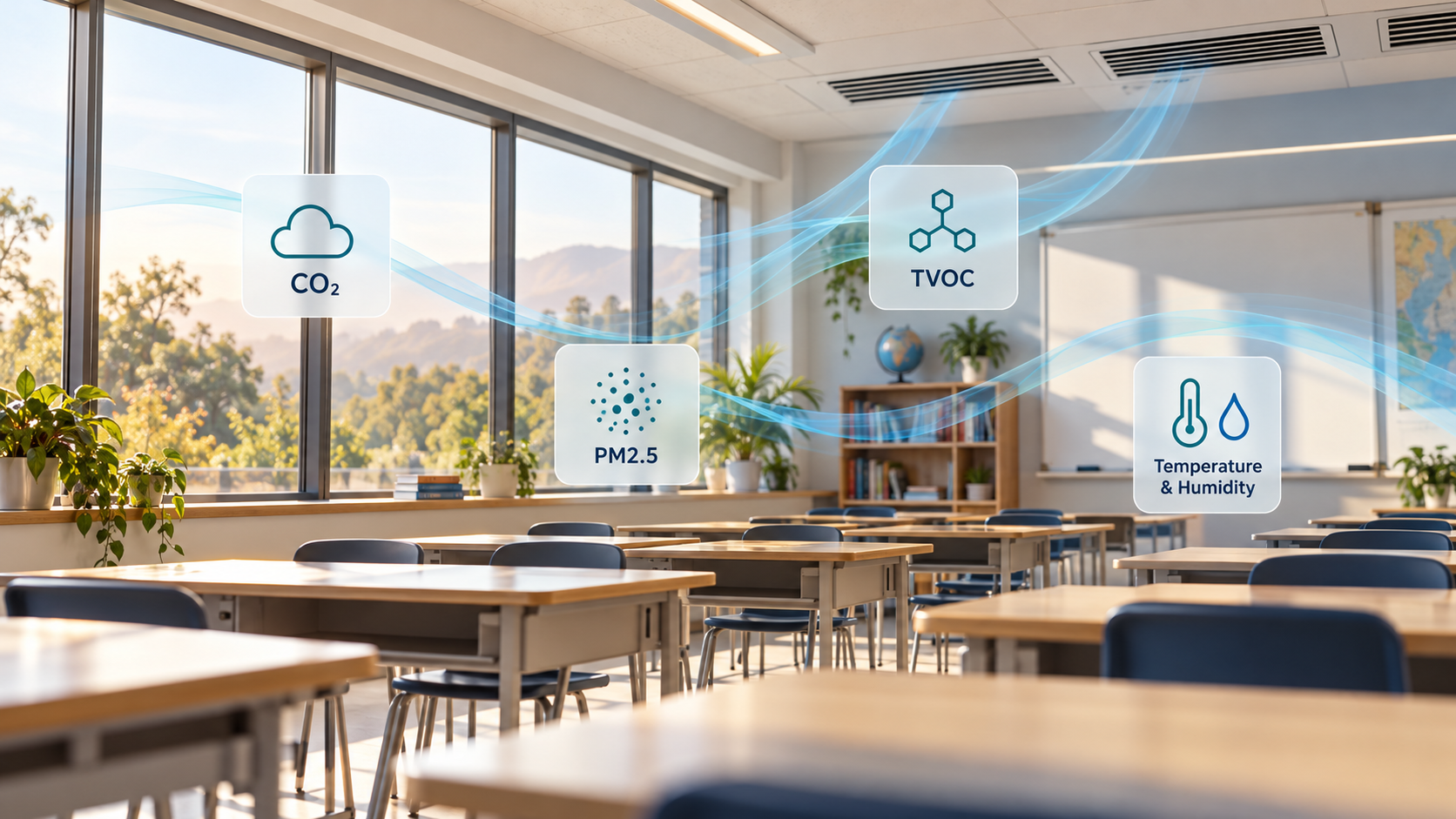
- Carbon dioxide (CO2): Helps staff spot patterns that may indicate inadequate ventilation.
- Carbon monoxide (CO): Tracks a combustion-related gas to support air-quality investigations.
- Nitrogen dioxide (NO2): Helps identify changes in a pollutant associated with traffic exhaust and other combustion sources.
- Total volatile organic compounds (TVOCs): Tracks chemical vapors that may come from cleaners, paints, and furnishings.
- Formaldehyde (HCHO): Supports investigations involving emissions from certain building materials and furnishings.
- Particulate matter (PM1.0, PM2.5, and PM10): Tracks airborne particles across three size categories, useful for investigating smoke and dust.
- Ethanol (ETOH): Adds context about alcohol-related vapors, including those from some cleaning products.
- Temperature and relative humidity: Helps staff investigate uncomfortable rooms and persistent humidity.
- Sound level: Shows when noise levels change or become a recurring concern.
- Air Quality Index (AQI): Summarizes selected pollutant readings to make air-quality changes easier to spot.
- Health Index: Combines particle, temperature, humidity, and TVOC data into a broader environmental indicator.
- Humidex: Combines temperature and humidity to help explain how warm a space feels.
For a detailed breakdown, see Triton ULTRA Environmental Metrics Explained.
How schools have used these insights
Identifying ventilation problems
Triton customers have used ULTRA’s CO2 readings to uncover ventilation concerns that might otherwise have gone unnoticed. Seeing elevated levels repeatedly in the same area gives facilities teams a clearer picture of where and when to investigate.
Staff can use that information to check HVAC schedules, outdoor-air supply, and blocked vents. After making adjustments, they can review the readings under similar conditions to see whether ventilation has improved.
Finding where wildfire smoke gets inside
Over the last few summers, smoke drifting down from Canadian wildfires has brought air-quality concerns to schools far from the fires themselves. For some Triton customers, ULTRA’s readings revealed that smoke was making its way indoors, even with the windows closed.
Those readings helped schools narrow down affected areas and find gaps around doors, windows, and other openings where outside air was getting in. By tracking particulate levels, including PM2.5, facilities teams could identify areas that needed better air sealing and monitor indoor conditions after repairs.
Rethinking cleaning products
Triton customers have observed poor air quality after a particular cleaning product was used. Seeing that change prompted them to switch products with student exposure in mind.
TVOC readings can help staff spot changes in chemical vapors around cleaning times, while ETOH readings can add context when alcohol-based products are involved. Those patterns give facilities and custodial teams a reason to review product selection, application practices, and ventilation.
After a switch, teams can compare readings during similar cleaning routines. Combined with product safety information, that feedback supports better-informed choices about what is used in student spaces.
More value from the same device
For schools already using ULTRA for vape detection, these capabilities give facilities teams another use for the same installed device: identifying environmental concerns, guiding action, and checking conditions afterward.