The Challenge: When Bathroom Breaks Became Breaking Points
Luling, Texas—best known as home to Buc-ee's, the world's largest convenience store—faced a challenge that wasn't making headlines but was quietly eroding the learning environment at Luling ISD. Bathroom vaping had become endemic across the district's campuses, with students disappearing during class time for extended periods and returning smelling of fruit-scented vapor.
Before implementing Triton, the district was fighting an uphill battle using traditional monitoring approaches. Staff members were pulled from other duties to conduct random bathroom checks, which proved ineffective and created staffing gaps elsewhere. Students quickly learned the patrol patterns and adjusted their behavior accordingly. Anonymous tip lines generated leads, but by the time administrators could respond, the evidence had literally evaporated into the air. Teachers reported growing frustration as the same students would request bathroom passes multiple times per period, sometimes disappearing for 15-20 minutes at a time.
The problem extended beyond health concerns. Bathrooms had become congregation points where disciplinary issues multiplied. What began as vaping sessions often escalated into confrontations, with fights breaking out among students who felt territorial about their preferred vaping locations. Class time was hemorrhaging as students lingered in restrooms, and the district's disciplinary data showed a troubling correlation between bathroom vaping hotspots and other behavioral incidents.
The Discovery: A Technology-First Approach
The district's turning point came during a regional administrators' conference where a neighboring district presented data on their air quality monitoring initiative. Luling ISD's leadership team recognized that their reactive approach—chasing after incidents that had already occurred—would never solve a problem that was happening in real-time behind closed doors.
After evaluating several solutions, Luling ISD selected Triton for its comprehensive sensor capabilities and proven track record in Texas school districts. The decision was made to implement Triton Sensors across all campus restrooms, creating a complete monitoring network that would provide immediate alerts when vaping was detected.
Implementation: Building an Integrated Safety System
Triton sensors were installed in every restroom across Luling ISD's campuses in early March. But the district didn't stop at vape detection—they leveraged Triton's full suite of features to create an intersectional approach to school safety and student well-being.
The vape detection technology was paired with sound anomaly detection to identify verbal altercations before they escalated into physical confrontations. Triton's patented radar sensors helped track unusual loitering patterns that might indicate students skipping class. Temperature and humidity monitoring ensured restroom environments remained healthy and comfortable, removing excuses for students to avoid facilities.
The administrative team configured the system to send real-time alerts to designated staff members' mobile devices, enabling rapid but discreet intervention. Rather than posting staff outside bathrooms or conducting disruptive sweeps, administrators could respond precisely when and where issues occurred.
The Results: A Dramatic Turnaround
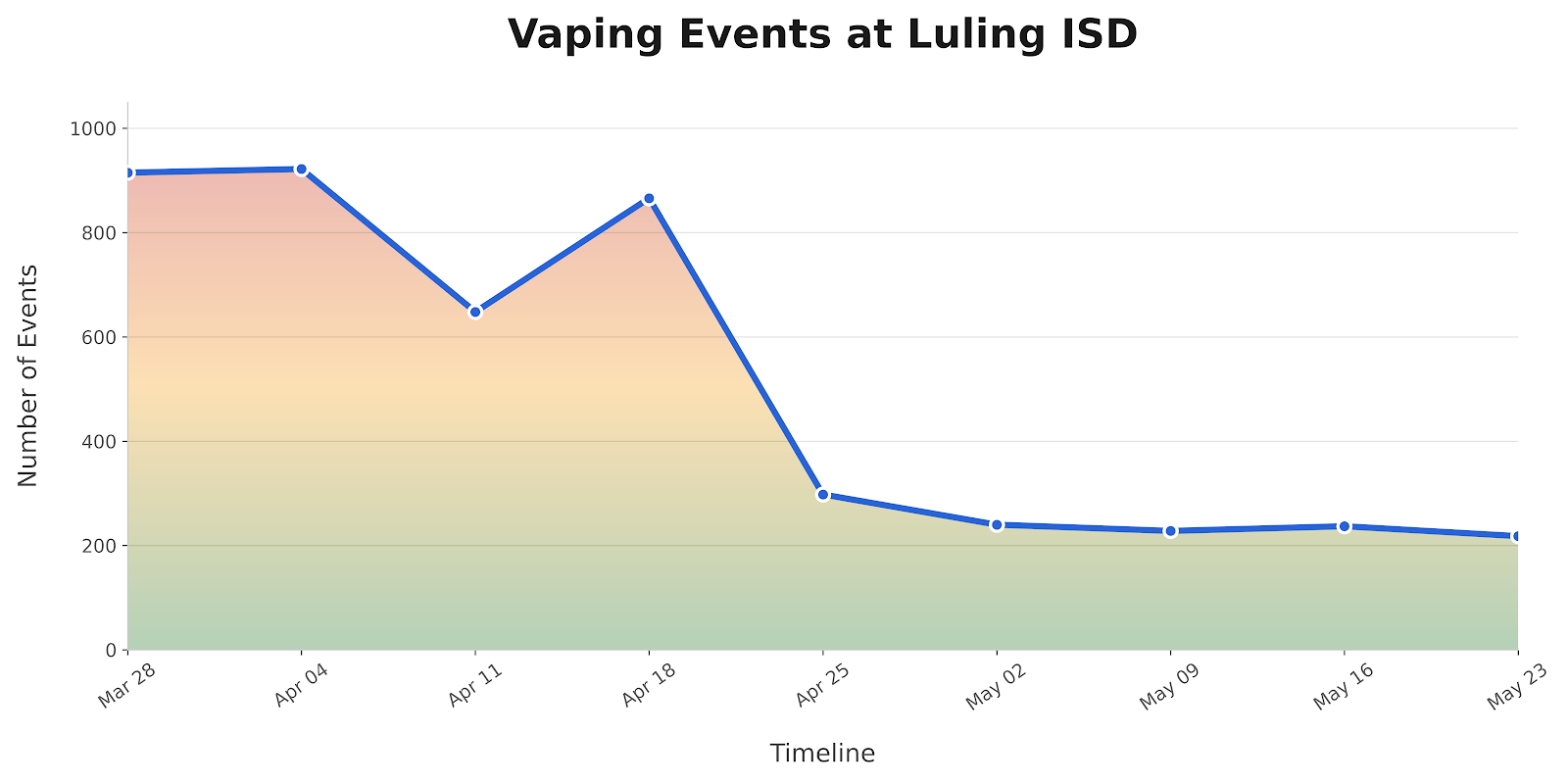
The data tells a compelling story. In late March, when monitoring began, Luling ISD recorded over 900 vaping events district-wide. Within just two weeks, that number had dropped to approximately 650 events—a decline that accelerated as students realized their behavior was no longer invisible.
By late April, vaping events had plummeted to around 300 per week. By early May, the district was recording fewer than 250 events—a 77% reduction from the baseline in just eight weeks. The curve continued to flatten, stabilizing at approximately 200 events by late May, representing a sustained behavioral change rather than temporary compliance.
But the quantitative data only tells part of the story. The intersectional benefits of comprehensive sensor monitoring became immediately apparent across multiple dimensions of school operations.
Reduced conflicts and violence: With fewer students congregating in bathrooms for vaping, the district saw a notable decrease in bathroom-related fights and altercations. The sound anomaly detection allowed staff to intervene in verbal disputes before they became physical, and the reduction in territorial behavior over vaping spots eliminated a significant source of student conflict.
Increased instructional time: Teachers reported that chronic bathroom-pass requesters were now staying in class. Students who had previously spent 15-20 minutes per period in restrooms were now taking legitimate 3-5 minute breaks. Across a district with hundreds of students and six class periods per day, this translated to thousands of additional instructional minutes recovered each week.
Improved campus climate: With bathrooms no longer serving as unsupervised social hubs, the district noticed improvements in overall campus atmosphere. Students who had avoided certain restrooms due to vaping or intimidation now felt comfortable using all facilities. Staff morale improved as administrators could respond to issues proactively rather than constantly playing catch-up.
Data-driven discipline: The Triton system's detailed reporting allowed administrators to identify patterns and repeat offenders with precision. Rather than relying on rumor or catching students in the act, the district could have informed conversations with families backed by objective data about frequency and timing of incidents.
Unique Insights: What the Data Doesn't Show
Several unexpected benefits emerged from Luling ISD's Triton implementation that wouldn't be captured in a traditional product spec sheet.
The deterrent effect proved more powerful than the enforcement mechanism. Once students understood that vaping was being detected, many simply stopped trying. The district found that the mere presence of the sensors—combined with education about the monitoring system—prevented incidents that would have required disciplinary action.
The system also revealed patterns that informed broader policy decisions. Data showed that vaping incidents spiked during specific class periods and in certain locations, allowing the district to target interventions and adjust supervision schedules strategically rather than spreading resources thin across all times and places.
Parents who had initially been skeptical about monitoring technology became advocates when they saw the results. Families appreciated receiving early intervention for their students rather than discovering a developed vaping habit months later. The objective data helped remove the "he said, she said" dynamic from disciplinary conversations, making them more productive.
Staff members noted that responding to a discreet mobile alert was far less disruptive than conducting random bathroom sweeps or pulling students from class based on suspicion. The technology enabled them to maintain educational continuity while still addressing behavioral issues promptly.
Looking Forward
For Luling ISD, Triton Sensors have become an integral part of creating a safe, healthy learning environment where students can focus on education rather than dodging supervision. The dramatic reduction in vaping has created ripple effects across student health, instructional time, campus safety, and overall school climate.
As one of countless Texas districts tackling the youth vaping epidemic, Luling ISD's experience demonstrates that technology-enabled monitoring, when implemented thoughtfully and comprehensively, can achieve results that traditional methods simply cannot match. Just as Buc-ee's has become a landmark by thinking bigger than traditional convenience stores, Luling ISD is thinking bigger than traditional school discipline—and the data proves it's working.
Districts running the same playbook can see the school deployment page for placement and alert setup.
Luling is not alone: Match Charter is a district that cut vaping 79% across multiple buildings.
Districts still comparing vendors should start with the school buyer's guide.
.svg)