What Is Vaping and How Does A Vape Work? A Comprehensive Guide
Vaping may seem like a harmless thing to do, with soft clouds produced and sometimes tasty flavors. But there is much more going on that you should be aware of.
That’s why we put together this guide on what vaping is and how vapes work. Below, we take a look at how these battery-powered devices function, the types of liquids used and the ingredients found within them, and what is actually produced.
We also delve into why vaping has become a particular concern in schools and other shared spaces.
Let’s begin with the fundamentals.
What Is Vaping?
Vaping refers to the the use of an electronic device to heat liquid into an aerosol, which is then inhaled. The liquids, referred to as e-liquids, vape juice, or e-juice, contain a range of ingredients, with the most prominent being nicotine, or a synthetic equivalent. Nicotine is highly addictive and the active ingredient found in tobacco products.
Vape devices go by many names, including vape, vape pen, e-cigarette, pod, and mod. What sets them apart from smoking is the lack of combustion and burning. Vapes gently heat liquid. However, it’s important to remember that the vapor produced is not harmless steam or water vapor, but a cloud of tiny liquid particles and chemicals.
So that’s what vaping is, let’s take a look at how vapes work.
How Does a Vape Work?
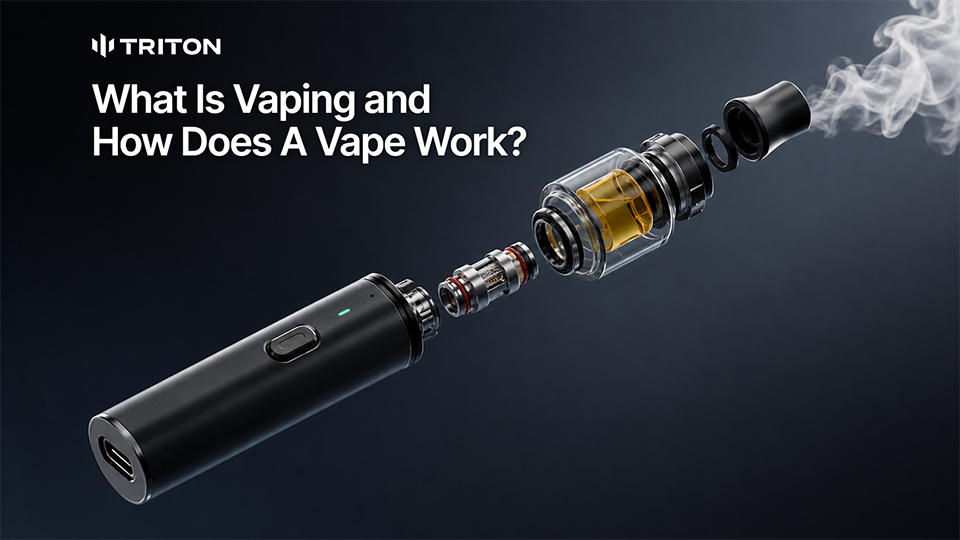
Vapes work in quite a simple way: they use a battery to heat a small coil, which turns liquid into vapor, which is then inhaled by the user.
Some vapes have heating elements called atomizers. When activated, these devices heat a wick which is soaked in e-liquid.
One of the draws of vapes is how easy they are to use. The devices sometimes have a button on them which activates the heating process. Others simply require you to inhale, and the heating will take place automatically.
Let’s break down these devices further.
Anatomy of a vape
Whatever their shape or size, most vapes share these same core parts:
- Battery: usually a rechargeable lithium-ion battery that powers the device.
- Atomizer and coil: the heating element that warms the liquid into an aerosol.
- Wick: absorbs e-liquid and feeds it steadily to the coil.
- Tank, pod, or cartridge: the chamber that holds the e-liquid.
- E-liquid: the liquid that is heated and turned into aerosol.
- Airflow sensor or button: triggers the heating element.
- Mouthpiece: the opening the user inhales through.
- Circuit board: on more advanced devices, controls power, temperature, and settings.
Rechargeable versus disposable vapes
It’s possible to purchase vapes that you can refill and recharge, and those which are designed to be disposed of after they run out of liquid.
Rechargeable vapes are more environmentally friendly and allow you to recharge the battery and refill or add cartridges of liquid.
By contrast, a disposable vape is securely sealed, with a built-in battery which usually cannot be recharged. Once it runs out, you have no choice but to throw it away.
Disposable vapes, which are usually cheaper, have been associated with lower quality. In the United States, all e-cigarettes need authorization from the Food and Drug Administration (FDA) before they can be legally marketed, yet many disposable vapes are sold without that authorization.
Types of Vapes and E-Cigarettes
Vapes come in all different shapes and sizes. Some offer different levels of power, the ability to produce larger clouds of vapor, and how refillable they are. We’ve touched on some types of vapes already, but below, you can find a breakdown of the key varieties:
- Cigalikes: small devices shaped like a traditional cigarette, often among the earliest e-cigarettes.
- Vape pens: slim, pen-shaped devices with a refillable tank and a rechargeable battery.
- Pod systems: compact devices that use pre-filled or refillable pods, including the well-known JUUL style.
- Box mods: larger, more powerful devices with adjustable settings, favored by hobbyist users.
- Disposables: sealed, single-use devices that are pre-filled and thrown away when finished.
It’s also important to note the distinction between closed vapes systems and open vape systems. These are the formal terms for your ability to access the liquid. Closed systems are usually sealed with pre-filled cartridges. Open systems usually allow you to add your own liquid.
While some vape pens are designed for nicotine-based products, others are used for cannabis products containing THC. Depending on the legality of marijuana in certain states, THC vapes could look more discreet than other types of vapes. Some are even disguised to look like everyday objects, like USB drives, pens or highlighters, making them easy to conceal in the likes of schools.
What Is Inside a Vape? (E-liquid explained)
It’s important to be aware of the ingredients used in vapes, as well as the risks associated with these ingredients. Here are the most commonly found:
- Propylene glycol (PG) and vegetable glycerin (VG): the base of the liquid. PG carries flavor and gives the sensation often called a throat hit, while VG is thicker and produces the larger visible clouds. Some people report problems like sore throats and coughs which can sometimes be caused by these ingredients.
- Flavorings: a wide range of food-grade and other flavor chemicals, from fruit and dessert to mint and menthol are used in vapes. However, some studies have found that when heated, these flavorings behave in uncertain ways, meaning they could be causing harm.
- Nicotine: present in most products, in one of two forms. Freebase nicotine is the traditional form, while nicotine salts, or nic salts, allow much higher concentrations to be inhaled smoothly, which is why they are common in pods and disposables. It is highly addictive and associated with a range of problems, from tiredness and fatigue to acne.
- Water
Traces of toxic metals like lead have also been found in the vapor produced by these devices. This can be caused by the likes of cheap coils being used, which break down after usage.
To learn more about the chemicals found in vapes, why not check out our dedicated guide here?
What Vaping Produces in the Air
While it may seem harmless, vaping doesn’t just produce water vapor or steam. These white clouds produce a cocktail of chemicals and particles that linger in the air and can be breathed in by others.
Nicotine is the biggest offending chemical produced by vape devices. It is almost always carried in the aerosol and can be breathed in by other people.
We also mentioned above that in some cases, traces of heavy metals have been found in vapor. This includes lead, nickel, and chromium, which are all highly toxic to humans. Unwittingly, people may be inhaling them directly into their lungs.
Also found in vapor are carbonyls, a group of chemicals which are also found to be toxic to humans too. They include formaldehyde, acetaldehyde, and acrolein, which can form when e-liquid is heated, particularly at higher temperatures.
Research is still ongoing to the long-term effects of vaping, as well as the second-hand impact of emissions. But as you can see, vapes do have the potential to be harmful to people, especially young people and children. Let’s take a closer look at that.
Why Is Vaping a Concern in Schools and Shared Spaces?
As we’ve explained, vapes contain many ingredients, some of which are particularly harmful to young, developing brains.
Nicotine, for example, has the ability to change a child’s behavior with its highly addictive nature. Given its effect on the body, it can also cause problems like headaches in children, and contribute to problems like acne.
Given how easy they are to use, the attractive flavors and packaging, vapes have found their way into the hands of millions of children in the US. Schools have found it difficult to police their use given how vaping is scentless and vapor dissipates quickly.
Here at Triton Sensors, we’ve seen many cases like this, and we’re pleased to say that we’ve been able to effectively tackle many problems of vaping in schools through our state of the art vape detectors.
How is vaping detected?
In order to tackle the issue of vaping in schools, many institutions have turned to vape detectors. These discreet devices can be fitted in vaping hotspots, like bathrooms and locker rooms. When they detect the presence of vapor and the chemicals found within it, an alert is triggered, allowing school staff to catch them in the act.
Vape detectors have proven hugely effective in reducing vaping incidents. In some cases, it’s lead to reductions of up to 80% in just a few weeks.
Get Help and Support With Vape Detection
Now that you’ve read all about vaping and how vapes work, you may be in a position where you need to tackle a problem surrounding the use of vapes, for example, if you’re a teacher or work in education. If so, Triton Sensors can help.
Our advanced vape detectors provide continuous, accurate coverage without invading anyone’s privacy or rights. When triggered, our discreet devices send subtle alerts to supervisory staff. This allows them to make proper interventions and enforce no-vaping policies with greater effect.
If you’re still unsure, we offer a demo sensor which you can request here.
We also offer free quotations and can discuss your issues and needs in detail to provide you with exactly what you need for the problem you’re trying to tackle.
To reach out to us today, just tap here or call us on the number above.