Teen vaping remains a serious public health concern in the United States. Vaping has been touted as a better alternative to smoking tobacco, and the market has exploded. But the fear is that harmful products are reaching the hands of children, and the impact they can have on them can be profound.
In this article, we examine the most reliable and up-to-date statistics on teen vaping, drawing on data from US government agencies and respected research organisations. We also look at the impacts vaping can have and the best prevention methods available right now.
Teen Vaping Statistics: A Summary
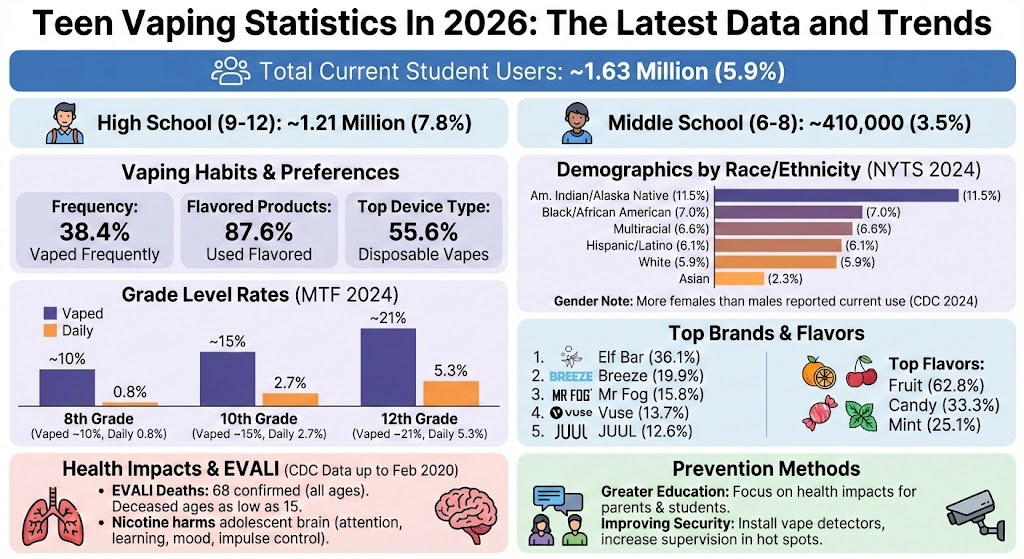
- According to the latest available data, around 1.63 million middle and high school students currently use e-cigarettes. This is around 5.9% of all students.
- Around 1.21 million high school students currently vape. That’s around 7.8% of all high school students.
- 410,000 middle school students reportedly vape, which is around 3.5% of all pupils that age.
- 38.4% of all surveyed vaped frequently
- Of all vaping teens, 87.6% used flavored products, 55.6% used disposable vapes, and 36.1% vaped Elf Bar products.
Key Information On The Data
Before delving into the data, it’s important to be aware of a few key terms and phrases:
- Vaping - this term means inhaling vapor from an electronic device, which is often called an e-cigarette or vape. The process involves liquid being heated to produce the vapor which is then inhaled.
- E-cigarette - this is the device that contains liquid which is then heated to produce vapor. Liquids contain a mix of ingredients, with nicotine or a synthetic variant included, as well as flavoring agents.
- Teen - in this context, the word “teen” refers to a “youth” who is typically a child between the grades of 6 to 12, generally in middle school and high school.
Now let’s take a look at the latest teen vaping statistics.
How Many Teens Vape In The US? The Statistics In Detail
The latest available statistics on teen vaping primarily come from the 2024 National Youth Tobacco Survey (NYTS), published by the FDA and CDC in 2024–2025. A number of other charitable organizations, academics and research institutions have also provided data, which we’ve also drawn upon too.
Below, you can find detailed breakdowns and teen vaping statistics for age, grades, demographics, and more.
Age Breakdown
The most current official breakdown on the age of teen vaping comes from NYTS 2024. It found:
- Middle school (grades 6–8), with an age range of 11 to 14. The NYTS found 3.5% current e-cigarette use amongst this age group.
- High school (grades 9–12), with an age bracket of 14 to 18. Research found vaping to be over twice as high as in middle school students, at 7.8%.
Grade Level Rates
To gain an insight into vaping among grade levels, it’s necessary to turn to the Monitoring The Future (MTF) study and review of 2024, which looks at drug use among teens. In relation to nicotine vaping, it was found:
- About 10% of 8th graders reported vaping
- Around 15% of 10th graders reported vaping
- Approximately 21% of 12th graders reported vaping
Daily nicotine vaping (past 30 days, every day):
- 0.8% of 8th graders reported daily vaping
- 2.7% of 10th graders reported daily vaping
- 5.3% of 12th graders reported daily vaping
One clear trend from these findings is that as children move through high school, the chances of them vaping increase. And what can begin as a mild, occasional thing becomes a daily habit for a lot of children.
Vaping By Demographics
The NYTS survey includes a clear race and ethnicity breakdown for current teen vaping across both middle and high schools. Here are the key figures:
- Non-Hispanic American Indian and Alaska Native students: 11.5%
- Non-Hispanic Black or African American students: 7.0%
- Non-Hispanic multiracial students: 6.6%
- Hispanic or Latino students: 6.1%
- Non-Hispanic White students: 5.9%
- Non-Hispanic Asian students: 2.3%
The CDC also notes in its findings that in 2024, more females than males reported current e-cigarette use.
How Many Teens Have Died From Vaping
It’s possible for people to suffer an E-cigarette or Vaping product use-Associated Lung Injury (EVALI). In some cases, these injuries can prove fatal, especially when illicit chemicals are used in products.
The CDC, up until 202,0 recorded deaths resulting from EVALI. This is the latest available data. It found:
- 68 confirmed deaths (all ages) as of February 18, 2020.
- Among 2,668 hospitalized EVALI cases or deaths reported to the CDC (as of January 14, 2020), 15% of patients were under 18 years old.
- The age range of deceased patients included ages as low as 15.
Statistics By Device Type And Brand
Reliable data on the types of devices that teens use can be found in the study, E-Cigarette and Nicotine Pouch Use Among Middle and High School Students by Park-Lee et al (2024). It found:
- Disposables e-cigarettes - 55.6%
- Prefilled or refillable pods or cartridges - 15.6%
- Tanks or mod systems - 7.0%
- Don’t know device type - 21.8%
The same study also looked at the most popular vaping brands among teens. It found:
- Elf Bar - 36.1%
- Breeze - 19.9%
- Mr Fog - 15.8%
- Vuse - 13.7%
- JUUL - 12.6%
The most flavor types were fruit (62.8%), candy (33.3%), and mint (25.1%).
What Are The Reported Impacts Of Teen Vaping?
Why all of this data matters, and why we’re reporting on it, is because the impact vaping can have on children is significant.
Not only does it have a short-term impact on education, affecting the likes of focus, attention span and behavior, but the effects can also stretch into the long term, with the habit developing into an addiction.
The main harmful ingredient in vape pens is nicotine. As reported by the CDC, nicotine has the potential to harm the developing adolescent brain. In particular, it can impact the areas relating to attention, learning, mood and impulse control.
In other terms, this can disrupt a child’s attention span when in school. It can make them sluggish, tired, unable to focus on teachers. It can also make them withdrawn and less sociable. Students with vaping problems often see their educational performance slide.
How To Prevent Teens From Vaping
For the likes of teachers, school staff and parents, preventing teenagers from vaping can feel like holding back a river with your bare hands. Odorless and smokeless, vapes are hard to detect and the small devices can easily be hidden.
However, there are methods to reach children and help them to tackle the habit before it becomes an addictive problem. Here are some of the best methods:
Greater Education
From the perspective of parents and teachers, one of the best steps to take to prevent teens from vaping is to improve the education surrounding the subject. This just doesn’t go for children, but for adults as well.
Vapes are new to the market. Chances are, they’re new to you as well. Your child may know even less about them, and, unwittingly, they may end up causing harm to themselves. It’s therefore important to learn as much as possible about vape pens, their ingredients, and the different types. This way, you can share your knowledge and understanding and guide your child away from them.
The same applies to schools and teachers. Greater efforts to educate students within the classroom on the impact of vaping can yield results. Honing in on health impacts, and explaining why they may suffer from symptoms like tiredness, acne and headaches can cut through and hopefully make an impact.
Improving School Supervision and Security
For those students and teens who insist on vaping, or perhaps are finding it tough to quit, other methods can be taken.
One of the most effective, especially for schools, is to install vape detectors within their premises. Hot spots like bathrooms, locker rooms and quiet stairwells can lead to drastic reductions in vaping incidents, and within a short space of time. In one case, we helped Collinsville Public Schools reduce vaping by over 90% in just a few weeks.
As well as improving technology onsite, greater supervision by staff of hot spot areas and during break times can also contribute to an effective prevention strategy.
Frequently Asked Questions (FAQ)
Below, you can find answers to some common questions surrounding teen vaping statistics.
Do Most Teens Who Vape Use Flavored Products?
Yes. NYTS 2024 reports 87.6% of current youth e-cigarette users used flavored products.
What Type Of Vape Device Do Teens Use Most Often?
Disposables are most common. NYTS 2024 reports 55.6% of current youth e-cigarette users most often used disposable devices.
Which Vape Brands Are Most Common Among Teens?
NYTS 2024 lists Elf Bar as the most commonly reported brand among current youth e-cigarette users (36.1%), followed by Breeze (19.9%), Mr Fog (15.8%), Vuse (13.7%), and JUUL (12.6%)
Have Teens Died From Vaping?
The CDC has reported 68 confirmed deaths (all ages) as of February 18, 2020, with deceased ages ranging from just 15