Mold is one of the most expensive and disruptive problems a school facilities team deals with, and it is almost always found too late. By the time someone spots a stain on a ceiling tile or catches that musty smell in a locker room, the growth has usually been underway for weeks or months. Then come the remediation costs, the displaced classrooms, and the calls from parents.
The good news is that mold is preventable, and the conditions that cause it are measurable. If you can see the moisture building up before growth starts, you can fix the problem while it is still a maintenance ticket instead of a remediation project.
Prevention starts with visibility
Mold needs two things to grow: moisture and warmth. Those conditions build up quietly in the spaces no one walks through every day. A crawlspace holds humidity after a slow leak. A portable cools without drying out. A locker room's exhaust falls behind. None of it is visible on a walkthrough until it has already become a problem.
Continuous monitoring changes that. Instead of finding out about a wet, warm space months later, your team hears about it in hours, while the fix is still simple. That is the difference between prevention and cleanup.
What Triton ULTRA measures, and why it matters for mold
No single reading detects mold on its own. What the ULTRA gives you is several independent signals on one device, so you can see both the conditions that create risk and the early signs that growth has started.
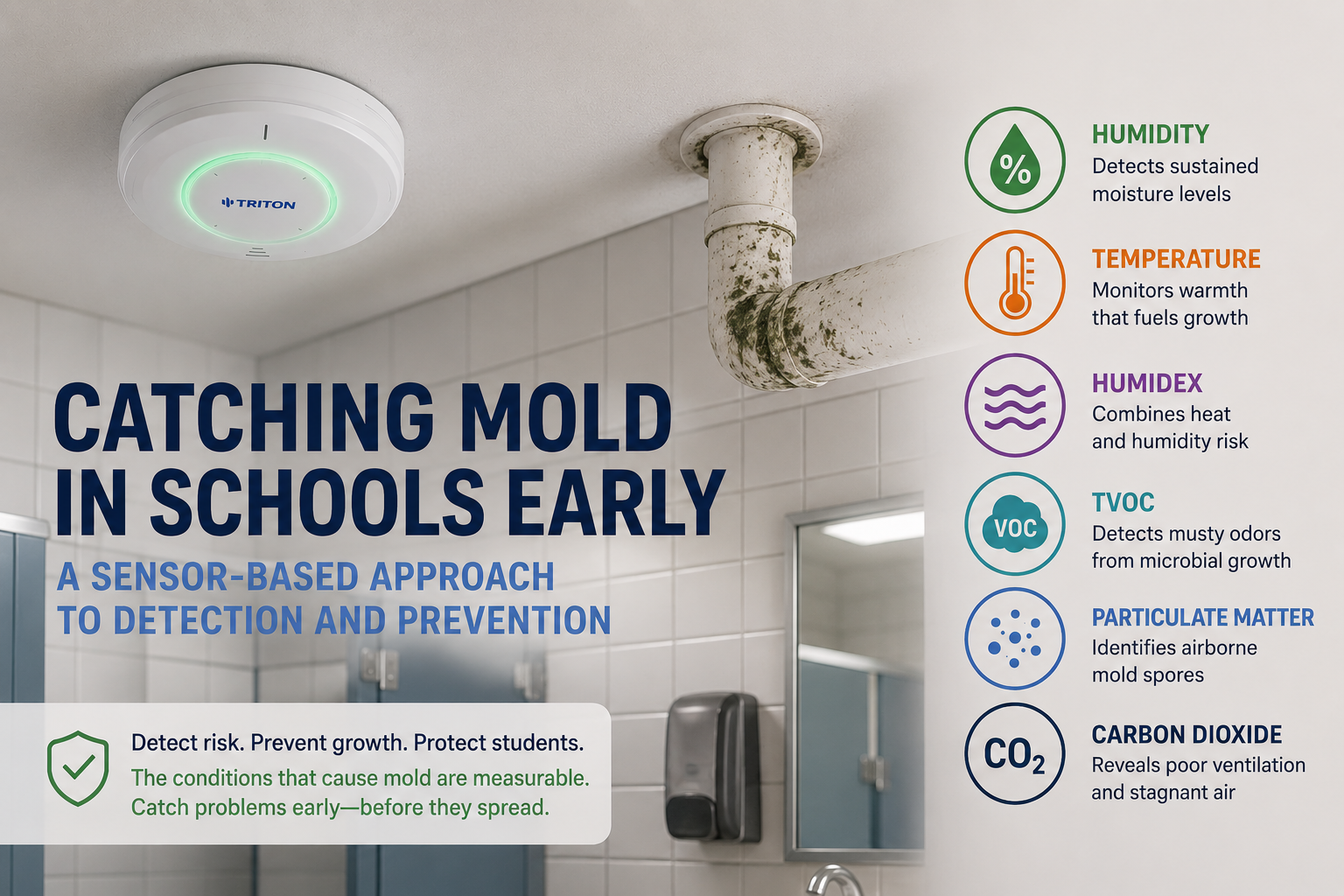
Temperature and relative humidity. The ULTRA measures temperature to within 1 degree C and relative humidity to within 1.5 percent, continuously, in every monitored room. Sustained humidity above roughly 60 percent RH is the level most districts watch, and catching it early is the whole game.
Humidex. Heat and moisture in one number. It reflects the combined effect of temperature and humidity, which is exactly the combination mold cares about. Set a limit per room and get alerted the moment a space drifts above it.
TVOC. As mold grows it releases microbial volatile organic compounds, the musty odor people associate with a mold problem. The ULTRA's TVOC sensor picks up rising VOC levels, which can flag active growth before it is ever visible. When elevated humidity and rising TVOC show up in the same room, that is a strong sign to go take a look.
Particulate matter (PM1, PM2.5, PM10). Mold spreads by releasing spores, which are airborne particulates. A rise in particulate counts in a closed, damp space is another signal that something is developing.
Carbon dioxide. High CO2 means the air is not moving, and stagnant air is where moisture lingers. It helps explain why a room is holding humidity in the first place, and points you straight at a ventilation fix.
Together these readings give you a full picture: not just whether conditions are risky, but whether the space is actually starting to have a problem, and often why.
Where to place sensors in a school
Start with the spaces most likely to have a problem:
- Locker rooms and pools. The wettest air in the building, and the first place exhaust problems show up.
- Crawlspaces and tunnels. Closed, unventilated, and rarely visited, so moisture sits there unnoticed.
- Portables and classrooms. Cycling HVAC can cool a room without drying it, so humidity creeps up.
- Storage and roof-adjacent spaces. Summer shutdown and slow leaks turn into the problem found in August that started in June.
Built for daily operations, not a one-time inspection
One device, one install, one data stream. Set a humidity or Humidex limit per room and your team gets notified when a space stays above it. Up to six months of readings stay on the device, and Triton is an open platform, so you can visualize the data in our dashboards or send it wherever your team already works.
And because the same ULTRA is already handling vape detection and air quality, mold monitoring is not another system to buy, install, or manage. It is a capability you already have.
Start with your highest-risk rooms
You do not need to wire the whole district to see the value. A pilot in the locker rooms, a crawlspace, and one portable will show you what your buildings are really doing, and where the moisture problems are before they become damage.
Want to see it in your own buildings? Reach out at [email protected].